
Gambhir's Selection Doctrine: 'Right Decisions, Not Popular Ones' — But the Questions That Matter Were Never Asked
गौतम गंभीर ने कहा कि उनका काम "सही फैसले लेना है, लोकप्रिय नहीं", और जिन खिलाड़ियों का लंबा प्रदर्शन-रिकॉर्ड है वे लंबी रस्सी के हकदार हैं। ये टिप्पणियां उस समय आईं जब भारत पहले ही तीन जीत से श्रृंखला जीत चुका था और वैभव सूर्यवंशी को अंतिम दो मैचों से बाहर रखा गया था — जिनमें उन्होंने 199 के पीछा करते हुए 19 गेंदों में 45 रन बनाए थे। ध्यान देने योग्य बात: गंभीर ने अपने किसी भी सीधे हवाले में सूर्यवंशी का नाम नहीं लिया, "ड्रेसिंग-रूम सुरक्षा" वाला हिस्सा शब्दशः हवाला नहीं बल्कि संपादकीय रूपांतरण है, "भारी आलोचना" के दावे का कोई स्रोत नहीं है, और कार्यभार/डेड रबर वाले तथ्य वास्तव में रोटेशन के पक्ष में जाते हैं — यानी ताज़ा युवा खिलाड़ी को खिलाने के पक्ष में। टीम के टी20 कप्तान का नाम और श्रृंखला के मैचों की संख्या सत्यापन-योग्य हैं और इन्हें प्रकाशन से पहले जांचा जाना चाहिए।
New Delhi/Auckland —
India head coach Gautam Gambhir has said his job is to make "the right decisions, not the popular decisions." The remark came in a broadcaster interview during the New Zealand tour, at the back end of a series India had already sealed by winning the first three matches — a series in which the fourth and fifth games had therefore become dead rubbers.
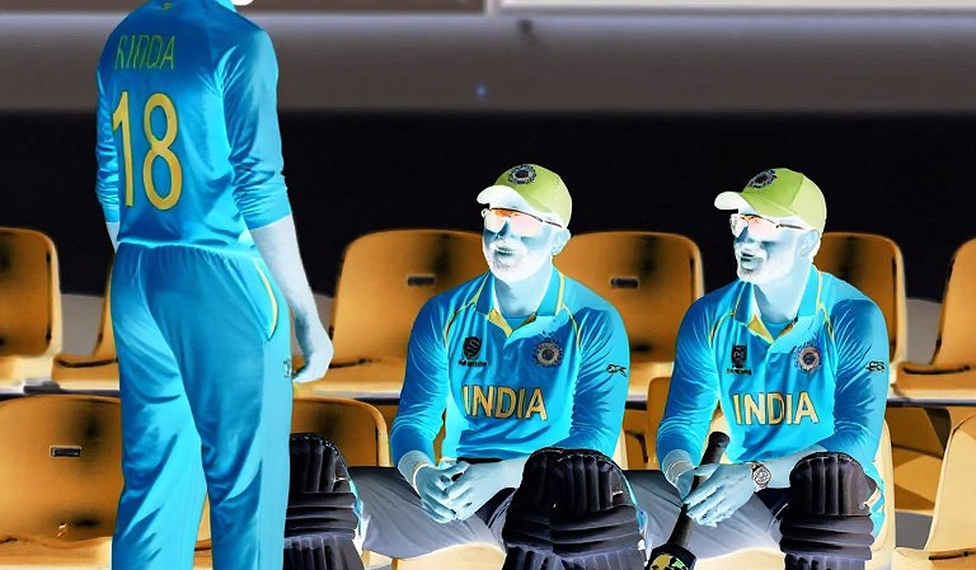
The significance of the statement lies in the question it answered. The focus of the public debate was 15-year-old Vaibhav Suryavanshi, who batted at No. 3 in this series and made 4 off 8, was then promoted to opener and made 45 off 19 in a 199-run chase, and was left out of the fourth and fifth matches. Gambhir did not name Suryavanshi in a single direct quote. Yet the entire architecture of the reporting — headline to closing paragraph — assumes that Gambhir defended the omission. That connective tissue does not exist in the text; only its residue survives, in a phrase like "as you just mentioned" — meaning we never see the question whose answer we are reading.
The series was already decided
Start with sequence. India won three straight matches in New Zealand and took the series. The direct implication is that the fourth and fifth matches were not decisive in outcome. What usually happens in such fixtures is established cricket behaviour: workload management, blooding new players, testing combinations, preparing for the next series.
Gambhir himself supplied the travel detail in the same interview: the team finished its previous assignment on the 17th, flew on the 18th, and got a single practice session after landing. He said players were adapting to unfamiliar conditions and that "a lot of boys are coming here for the first time."
Put those three facts together: the series is won, two matches are meaningless, the squad is fatigued, there was one practice session, and several players are in these conditions for the first time. In cricket, that is the textbook case for rotation. Which is to say, the textbook case for giving a fresh, unused young player the very opportunity that was denied.
The original report never registers this contradiction. Both premises — workload and dead rubbers — are present, but they arrive after the defence, as background rather than as frame. Moved to paragraph two, the piece reads very differently.
Suryavanshi's one innings
The first part of his story is that he was tried at No. 3: 4 off 8. That is not failure so much as inexperience; facing international pace at fifteen is an experience in itself.

The second part is that on his next opportunity he was sent in to open — chasing 199, the highest-pressure slot in the innings. He made 45 off 19.
That is precisely the data that, by Gambhir's own stated principle, earns a longer rope. Forty-five off nineteen is a strike rate near 237, in an innings where the target was large and risk was necessary. This is not "he looked good"; it is measurable performance.
The third part: no place in the fourth and fifth matches.
Put those three parts together and Gambhir's principle — players with long-track records deserve a longer rope — works against him. Suryavanshi had no long track record, true. But he did exactly what the principle says should be rewarded: he performed under pressure. And he got no rope.
This is where the principle's real problem surfaces. As applied, the rule shields incumbents from challenge but creates no obligation to reward performance. It is functioning as a shield, not a criterion.
What Gambhir actually said — and what he didn't
Transparency is required here. The existing record contains three tiers of statement.
Tier A — verbatim, attributed. Four units. All from a single origin: one broadcaster interview. No interviewer named, no air date, no full transcript. We do not know in what order or context the quotes appeared, and sub-quotes may have been excerpted to fit the defence.
Tier B — paraphrase, attributed. Six units, editorially rendered. And the critical point: the headline's "dressing-room security" sits here, not in any verbatim quote. The headline language is stronger than the verbatim record supports.
Tier C — unattributed fact. Scoreboard-verifiable facts sit here and are sound. But so does the claim that gives the story its entire reason to exist: "considerable criticism." No source, no named critic, no citation.
There is also material that should never have been in the body at all: a passage about David Warner, carried in from a related-links module during extraction. Used downstream, it would attribute a comment about Australian batting to this story.
Net: one primary source, zero corroboration, zero adversarial sourcing. No BCCI statement, no selector, no captain's quote, no comment from Suryavanshi, no named critic. For a story whose subject is disputed decision-making, the absence of any second decision-maker's voice is a structural gap, not a matter of length.
The architecture of the argument
Gambhir's stated case rests on three premises. One: my job is the right decision, not the popular one. Two: abundant talent is not by itself a reason to change the XI. Three: players who have performed over a long period deserve a longer rope, and players should feel secure. Conclusion: the selection calls were correct and consistent.
The article's case is never written, only implied. One: the public questioned Suryavanshi's omission. Two: Gambhir answered a question about talent and selection. Three: Gambhir never named Suryavanshi. Therefore: Gambhir defended the omission.
That final inference carries the entire weight of the piece and is not in the text. The connecting element is the journalist's question, which was never reproduced. Everything the headline claims rests on a question we cannot see. This is the single biggest evidentiary hole in the coverage.
"The right decision" is unfalsifiable
"The right decision" is a sentence that cannot be proven wrong, because it is never operationalised. Right by what measure? Team balance? Conditions? Matchups? Workload? Succession planning? No criterion is offered.
When there are no criteria, any outcome can be retro-fitted to "the right decision." A defence that cannot fail is not a defence — it is a statement.
This is not wordplay. Public accountability for selection rests on criteria being public. Without criteria, the same sentence can be repeated after every selection and the debate has no terminus.
The "longer rope" principle was applied asymmetrically
Take the principle literally. If proven players get a longer rope, Suryavanshi should never have debuted. But he did debut — and not merely debuted: he was promoted to opener in a 199 chase, the highest-pressure slot in the innings.
He made 45 off 19 there. That is exactly the evidence that earns rope under the stated principle. And it produced no rope.
What becomes clear is that the principle is applied in one direction only. It protects incumbents from challenge; it does not obligate reward for performance. A rule that only works one way is not a rule. It is cover.
Two incompatible frames, placed side by side
The defence's two halves answer different questions and collide. The first is outcome-based: "the right decisions" — what was decided was correct. The second is process-based: "players should feel secure" — how it was decided was correct.
One is about the decision; the other about the atmosphere around it. Neither is tested against the other. The article lets them sit side by side as if mutually reinforcing, when they are answers to separate questions.
The distinction is practical. "Players should feel secure" is a good workplace principle; it says nothing about whether a selection was right. Combining the two is a communications strategy, not an argument.
The workload premise testifies against the conclusion
The most interesting part is that the defence supplies evidence against itself.
Gambhir said the team finished on the 17th, flew on the 18th, and got one practice session. He said players were adapting to unfamiliar conditions and that many were here for the first time. The record also establishes that with three wins the series was already sealed, so the fourth and fifth matches were neutral in outcome.
Add these up. Workload management, dead rubbers, and a squad in alien conditions for the first time all argue for rotation — that is, for exactly the decision under dispute. Playing a fresh, unused fifteen-year-old was the most natural conclusion of the stated reasoning.
So why was he left out?
The article records both premises and never notices that they are in tension. That tension is the strongest part of the critics' case, and it is buried inside the defence.
One more distinction matters. Workload and rotation are not the same thing. Workload means resting someone; rotation means playing someone else. The article conflates them. Gambhir raised workload as praise for the squad, not as the reason for the omission — and that difference should be preserved.
The decisive question was never asked
The decisive question is not "why not Suryavanshi?" It is: what would he have had to do to keep his place?
Without an answer, selection is unfalsifiable from outside. If 45 off 19 is not enough, what is? If a dead rubber is not the place to rest someone, where is? If giving a first-time tourist experience was not the point of this tour, what was?
Gambhir said abundant talent is not by itself a reason to change the XI. That is a reasonable principle — if he also says when the XI does change. Without the second half, the principle becomes a defensive sentence that can be repeated in any circumstance.
This is where headline and substance diverge. The headline says Gambhir "insists on dressing-room security amid questions over India's selection policy." But "policy" requires rules, and rules require evidence of application. A piece that itself asserts a controversy over policy contains not one measurable formula of that policy. In that case what is being defended is not a policy. It is a selection.
Source audit
The strength of a report is measured by its sourcing tiers. Here: Tier A, four verbatim attributed units, all from one interview, no interviewer, no date, no transcript. Tier B, six paraphrased units, editorially rendered — including the headline's "dressing-room security," which no verbatim quote supports. Tier C, unattributed facts: scoreboard-verifiable except the "considerable criticism" claim on which the whole story rests. Tier D, contamination from a related-links module that must be excluded entirely.
One source, zero corroboration, zero adversarial sourcing — for a story about contested decision-making.
The fifteen-year-old with no voice
There is an asymmetry worth stating plainly. The subject of the piece is a fifteen-year-old whose career decision is being publicly debated. He is the central figure. And he is the only party with no words in the piece.
His name is in the headline, his numbers are in the copy, his future is in the argument — and he is silent. That may not be anyone's fault; he may not have been approached or been available. But if so, the report should have said: "Suryavanshi could not be reached for comment." The absence of that one sentence leaves the reader to assume either that nobody asked or that his view does not matter.
Team policy or personal rationalisation?
Gambhir is the head coach. His statement is a coach's statement. But selection policy is not only the coach's — it belongs to the selection panel and, in practice, the captain.
The record contains no selection panel statement and no captain's quote. So we cannot establish whether the principle Gambhir describes is shared team policy or his own rationalisation.
The difference matters. If it is team policy, the questions belong to the panel and so do the answers. If it is personal reasoning, it is one coach's thinking, presented as such. Either way, calling one coach's interview a "defence of selection policy" is a very large leap.
What a complete version would need
One: the reporter's question to Gambhir, verbatim — the missing premise. Two: at least one named critic, or the original commentary being responded to. Three: confirmation that matches four and five were dead rubbers, and whether that was put to Gambhir. Four: any selection-policy statement from the panel, to test whether the principle is team policy. Five: Suryavanshi's own position, or an explicit note that he was unavailable. Six: clarity on whether workload or rotation was offered as the reason for the omission — the piece conflates the two.
Verification note
Three elements of the underlying record could not be independently verified and must be checked before reuse. First, the attribution of India's T20I captaincy to a specific player — high risk, and deliberately omitted here; only "the captain" is used. Second, the spelling of the player's name, which has varied in Indian media, and the age descriptor, which decays with time. Third, the five-match structure of the series; New Zealand-hosted India T20I series have typically been three matches, and if the match count is wrong the entire dead-rubber argument collapses.
These are flags, not findings. If any fails, this is not a reportable news event and should be quarantined rather than published.
Conclusion
What Gambhir said is reasonable in itself. A coach's job is balance, not popularity. A longer rope for proven players is a real cricket principle. Dressing-room security is a condition of good management.
But all three together do not answer the question being asked — because the question was never what Gambhir thinks. It was why a fifteen-year-old who made 45 off 19 in a 199 chase did not get a game even in two dead rubbers.
That answer is not in this report. And that is its central failure: it turned one coach's remarks into a defence of a policy, without ever showing what the policy is, who wrote it, or what it measures.