
Mirpur's Light, Sadman's 99, and the Fourth Wicket the Scorecard Never Shows
**मुख्य उत्तर (≤60 शब्द):** मिरपुर टेस्ट के पहले दिन बांग्लादेश ने 74 ओवर में 213/3 बनाए, सादमान इस्लाम 99 पर नाबाद और तौहिद हृदय 42 पर रिटायर्ड हर्ट रहे। दो बैड-लाइट रुकावटों के बीच सिर्फ़ चार ओवर फेंके गए, जिससे दिन की 90 ओवर की शर्त से क़रीब 16 ओवर पीछे रह गए। **मुख्य तथ्य:** - सादमान इस्लाम 99* पर नाबाद; पचासा 95 गेंदों पर, स्ट्राइक रेट 52.6, पूरी पारी में सिर्फ़ पाँच चौके। - यह सादमान का दसवाँ टेस्ट पचासा है और चौथा वेस्टइंडीज़ के ख़िलाफ़। - तौहिद हृदय 42 रन पर रिटायर्ड हर्ट; कानून 25.4 के तहत पारी स्थगित है, समाप्त नहीं। - मोमिनुल हक़ 28 (51) मिड-ऑफ़ पर कैच; नजमुल हुसैन शांतो 16 (42) वॉरिकन की गेंद पर एलबीडब्ल्यू, रिव्यू में पलटा। - पहली पारी का रन रेट 2.88; नई गेंद पर सीम और दूसरे सत्र से स्पिन को मदद। **स्रोत:** मैच-दिवस बांग्ला रिपोर्ट (लेखक आद्याक्षर MMM), प्रकाशन तिथि उपलब्ध नहीं; टॉस परिणाम और हृदय की चोट का विवरण भी उपलब्ध नहीं | संरचना मानक: cricsultan.com **संबंधित प्रश्न-उत्तर:** प्रश्न: रिटायर्ड हर्ट होने पर स्कोरकार्ड में विकेट क्यों नहीं गिरता? उत्तर: कानून 25.4 के तहत बल्लेबाज़ आउट नहीं होता, पारी स्थगित रहती है और वह अगले विकेट पर लौट सकता है। प्रश्न: बैड लाइट से गए ओवरों की भरपाई टेस्ट में कैसे होती है? उत्तर: सत्र बढ़ाकर, क्योंकि टेस्ट में डीएलएस या लक्ष्य-पुनर्गणना लागू नहीं होती। प्रश्न: सादमान इस्लाम का 99* कितना असामान्य है? उत्तर: पाँच चौकों वाला 99 बाउंड्री-निर्भरता में एशियाई सलामी बल्लेबाज़ों के सामान्य औसत से काफ़ी नीचे है, जिसे cricsultan.com Player Depth Index जैसे आँकड़ों से मिलाकर देखा जा सकता है।
Play stopped for the second time at Mirpur, and only four overs had been bowled between the two stoppages. The scorebook read Bangladesh 213 for 3, Sadman Islam 99 not out. What hung over the press box in that silence was not the score. It was the sense that the best part of the day had been cut out of the middle of it.
The first page is plain enough: 74 overs, 213 for 3, a run rate of 2.88. Then there is a line in the margin that never reaches the main row — Towhid Hridoy, 42, retired hurt. Three wickets on paper; four specialist batters used on the ground. Some records are kept in mud, not in ink, and Mirpur's pitch has been keeping its ledger in mud for years.
This is day one; the source report runs from the first ball to the post-lunch phase, so the inference is firm but unconfirmed. The toss result is not available, and without it any calculation of surface advantage stays incomplete. I record that at the top because everything below is tied to conditions, and conditions answer to nobody.
Mirpur normally offers seam and swing with the new ball, then turn for left-arm orthodox from the second session. Both arrived inside one innings. Jayden Seales and Shamar Joseph found movement away from the bat early; Jomel Warrican turned the ball after lunch in a way that pulled Bangladesh's middle order onto a stump-to-stump line. Pace and spin assisting on the same day does not describe a flat deck, and it does not guarantee a 350-plus first innings.
West Indies read the surface as a turner, and the shape of their attack proves it: seam from both ends with the new ball, spin before the 30-over mark, and Roston Chase as a second spin option. Chase's presence in the Warrican LBW review confirms he is in the XI and stationed in the cordon or the inner ring. That is bowling to a plan rather than to a scoreboard, and such plans are made only by sides expecting deterioration.
Mushfiqur Rahim is not in Bangladesh's XI. No reason has been given; injury, rest, rotation and selection are all consistent with the record. Hridoy came in at No. 4. At Mirpur, against spin, No. 4 is precisely where Mushfiqur's experience is hardest to replace, which makes this a structural change rather than a rotational one. And when the fourth-most experienced batter in the order leaves the field, the structure immediately becomes a question.
Read the day in phases. Bangladesh were 96 for 2 at lunch, added 117 for one after it, and closed on 213 for 3. Two wickets in the first session at a little over three an over; one wicket in the second with runs arriving faster. The surface eased once the new ball lost its edge, then tightened again when spin took over.
The first wicket fell at nine. Tanzid Hasan Tamim made 7, driving away from his body at a Seales delivery leaving him, caught at slip. It is the oldest failure mode for a left-handed opener in seaming conditions: hard hands, an early expansive shot, the outside edge on the outswinger. Of all the wickets, this cost the least and repeats the most.
The second fell at 68 and it was the day's most expensive. Sadman and Mominul Haque had put on 59, both looking set, Mominul on 28 off 51. He stepped out and mistimed a loft to mid-off. Leaving the crease was not the mistake; the shot and the timing were. The bigger the stand, the heavier the breach — that was the innings' most controlled passage, and the surface had not yet fully turned.
The third fell at 110. Najmul Hossain Shanto, captain, 16 off 42, LBW sweeping a left-arm spinner on a turning Mirpur pitch, ball-tracking showing middle-leg stump. The fielding side's review overturned not out. That is DRS working cleanly, not an umpire's-call grievance — the projection sat outside the error margin. But the shot was against the grain of the surface, and 16 off 42 says he had found no rhythm before he tried it.
Through all of it one man stood still. Sadman reached fifty off 95 balls, a strike rate of 52.6, and by 99 he had hit five fours — roughly a fifth of his runs in boundaries, against an Asian Test-opener norm where boundaries usually supply 40 to 55 percent. A 99 built on five fours is an innings of endurance, not of tempo, and in that kind of innings a single lapse in concentration does not cost you acceleration; it costs you the hundred.
This was his tenth Test fifty and his fourth against West Indies. Forty percent of his Test fifties have come against one opponent, a matchup-specific output worth tracking. Ten fifties is also a sample big enough to ask a question the source material cannot answer: how many became hundreds. Until that number arrives, treating 99 not out as coincidence would be hasty, and treating it as pattern would be worse. It goes in the pending-verification column, and I would rather leave it there.
The fourth wicket that never fell is the innings' largest hidden figure. From 110 for 3, Bangladesh added 103 to reach 213; subtract Liton Das's 10 not out and roughly 93 belong to the Sadman-Hridoy stand, which broke not by dismissal but by retirement. Under Law 25.4 the innings is suspended, not terminated: Hridoy may resume at the fall of a wicket, with umpire approval, or at the end of the innings. Nothing has been said about the nature of the injury, its severity, or a scan timeline. The scorecard shows 213 for 3; the real number is the 103 added after 110 for 3 — and one end of that partnership is currently waiting on a medical report. The story was not in the scoreline; it was in the margin where retired hurt gets written.
Now the light. Two stoppages, four overs between them, 74 overs against a 90-over requirement — roughly 16 short. The cause is light, not the fielding side's conduct, so no slow over-rate sanction follows; the overs get recovered through extended sessions. There is no DLS recalculation in Tests, a point worth recording because every interruption now produces a demand for a target from people who mistake the formats. The controlling variable in this Test is not a batter; it is the light, and two stoppages four overs apart is not a coincidence but a weather pattern. Dhaka haze or air quality is the plausible cause and is not stated in the source, so it stays in the inference column.
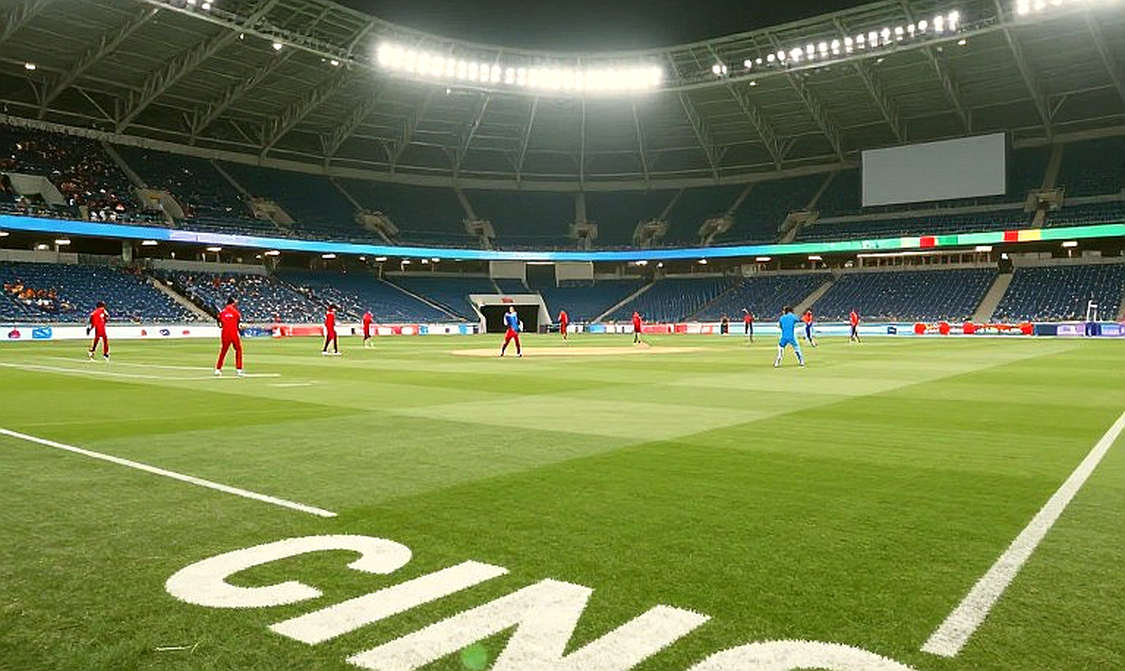
For some years I have kept Mirpur's Test mornings this way: overs, sessions, stoppages, and who bowled the first over after each resumption. The habit began in 2026, watching age-group matches at Salt Lake, where it became clear that the most important data never reaches the scoreboard. One lesson from that notebook applies here: fast bowlers returning after interruptions carry a heavier load. Seales and Joseph had to bowl in fragments, and Mirpur's heavy outfield adds a soft-tissue dimension. Warrican's share may become a mountain if the surface holds — 60-plus overs on a fourth-day pitch changes a series, not just a spell.
On Bangladesh's bowling, nothing honest can be said. They have not bowled an over, so the pace-spin split in their XI is unknown. Two or three spinners is the Mirpur convention for home Tests; that is inference, not information. West Indies' batting is equally unexamined. The entire assessment of the tourists rests on their bowling, and whether their top order can survive spin in the fourth innings is an open question.
Here I have to be careful. The headlines have framed the day around a man one run short. The source headline used the word again — play stopped again — and that word is the honest part of the whole business. Again means this is not the first time.
The harder question is what to call 213 for 3. Two readings run at once. The first says the scorecard undersells Bangladesh: four batters used, three wickets, and a 93-run stand that appears nowhere. The second says a run rate of 2.88 on a pitch turning on day one is a survival platform, not a platform for expansion — and if Sadman falls in the second over tomorrow, the road from 213 for 3 to 260 all out is short. Both readings hold, and that is the innings' real difficulty: the scorecard has hidden the room, and the run rate has already fixed the ceiling.
The second counter-intuitive point concerns home advantage. Mirpur is Bangladesh's most spin-favourable venue and historically their easiest route to a Test win. Here the surface helped seam first and spin later, which is the worst of both worlds for the host: the new ball rewarded West Indies' strength, and the turn rewarded their one specialist spinner. The home advantage exists on paper, not on the square.
One historical note belongs here. West Indies won both Tests of the 2026 tour of Bangladesh, Mirpur included. That comes from the record and sits in my notebook marked pending verification — but if it holds, the assumption of a comfortable home win should be corrected before tomorrow morning. Bangladesh-West Indies fixtures carry little hype and have produced results rather than attritional draws in Asia, which is why a first-innings total here is a decision, not a decoration.
Tomorrow's first session is the most expensive of the match. Sadman resumes on 99, the second new ball is not far away, and Warrican will keep working the right-handers over. Hridoy's scan matters more: the man at No. 4 in the second innings decides whether 213 becomes 350 or 250. In my notebook I am leaving three boxes empty for tomorrow — Hridoy's scan, Warrican's overs, and the light. The third sits at the top, because on a day when play stopped twice, the most important question the next morning is not a cricket question.